Yellow Leaves on Plants: 5 Causes and a Simple Test
Yellow leaves on plants are a diagnosis, not a verdict: five causes worth checking, from waterlogged roots to iron locked by pH, and a test that separates them.
Key takeaways
- Yellow leaves on plants are chlorosis: the tissue has stopped making chlorophyll, and the cause is one of five things — water, roots, nutrients, light and temperature, or normal ageing.
- Read the leaf's position first. Yellowing that starts on old leaves means a mobile nutrient or a root problem; yellowing on brand new leaves means iron, or a growing tip that is being damaged.
- Lift the plant and look at the roots. White and firm is healthy, rusty orange means too dry, dark brown or black means too wet, and no leaf symptom outranks that test.
- Fix one cause at a time and wait two weeks on new growth. A leaf that has already gone yellow never turns green again, so old leaves are evidence, not a scoreboard.
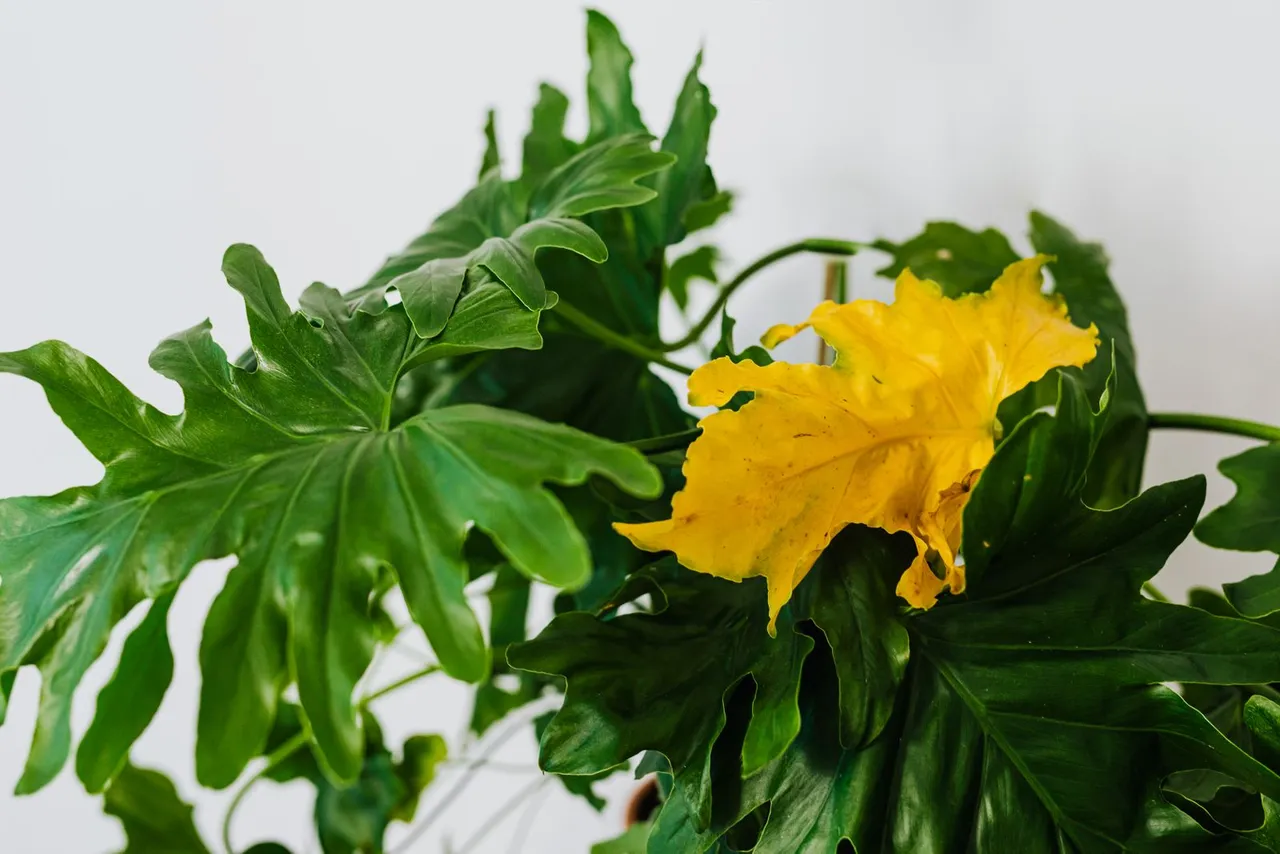
A plant cannot tell you what is wrong, so it prints the answer on its leaves, and yellow is the most common thing it prints. Yellow leaves on plants are a symptom with at least five separate causes, and the causes are treated in opposite ways. That is why guessing is expensive: water a plant because a leaf looks limp and you can drown roots that were already suffocating, and feed a plant because it looks pale and you can push soft growth onto something that simply needed a brighter window.
I have done both of those things to plants in my own pots, which is why the routine below is the one I now use. Read where the yellowing started, read the soil, then check the roots before you touch a watering can or a bottle of feed. It takes five minutes and it settles most cases.
Yellow leaves on plants: the short answer
Yellowing is chlorosis, which simply means the leaf has stopped making chlorophyll, the green pigment that turns light into sugar. The RHS chlorosis guide lists what sits behind it: nutrient deficiencies, pests, diseases, cultural problems such as waterlogging or drought, and in some cases the harmless end of a leaf’s natural life. Chlorosis describes the colour, not the cause.
The RHS guidance on leaf damage in houseplants comes at it from the houseplant side and names the usual suspects for yellowing in quantity: too much or too little water, overpotting, too shady a position, too cold a room, a sudden drop in temperature, draughts. Yellow leaves on plants are the visible end of one of those, which is why this guide works as a shortlist rather than a set of instructions in sequence.
So work in an order that removes candidates instead of adding guesses. First the position of the yellow leaf on the plant, old or new. Then water, because it is the most common cause and the easiest to measure. Then roots, which you can see in a minute by tipping the plant out. Then nutrients. Last of all light, temperature and draughts, which change more slowly and rarely produce a sudden flush of yellow.
There is one hard fact that saves a lot of wasted effort: a leaf that has fully yellowed will not go green again. What you are reading is evidence of a past condition. The proof of a fix is new growth, and new growth takes weeks.
Is the yellowing on old leaves or new ones?
Look at the whole plant before you look closely at one leaf. Damage that begins on the oldest leaves near the base and works upward is different in kind from damage that appears first on the newest growth at the tips.
Plants can move some nutrients out of an old leaf and into new growth. Nitrogen and magnesium are both mobile in that way, and the RHS notes nitrogen shortage as a general yellowing or reddening that starts on the older leaves, usually with a loss of vigour. Magnesium deficiency is the classic interveinal pattern — yellow between the veins, green ribs — and Washington State University’s Hortsense factsheet places nitrogen on old leaves and magnesium in that interveinal band as well.
Iron is the one that cannot be moved once it is in a leaf. Iron deficiency shows on the newest leaves first, and the Illinois Extension chlorosis page makes the same split from the other direction: iron starts at the young or terminal leaves and works inward, while manganese and zinc start on the older, inner leaves and move outward.
That single question — old or new — cuts the list roughly in half before you have touched anything. Old leaves first narrows to nitrogen, magnesium, potassium (whose yellowing shows most at the leaf edges), and anything that has damaged the roots. New leaves first narrows to iron, manganese, zinc, and physical damage to the growing tip. Read that way, the question of why the leaves are yellow stops being one problem and becomes a location on the plant.
Too much water: the cause behind most plant leaves turning yellow
If you only check one thing, check this. Compost that stays saturated displaces the air around the roots, and roots need oxygen as much as they need water. The RHS describes leaves yellowing under waterlogged conditions, and adds that if waterlogging persists you get leaf loss and dieback as well. It is the cause no bottle of feed can undo, and the one where plant leaves turning yellow is the last symptom you see before leaves start dropping.
The test that settles it does not involve a moisture meter. Tip the plant out of its pot and look at the roots. The Illinois Extension troubleshooting guide gives the colour scale: healthy roots are usually white, roots that are rusty orange to light brown have been too dry, and roots that are dark brown to black have been too wet. When plant leaves turning yellow sit above dark roots, the answer is literally in your hand.
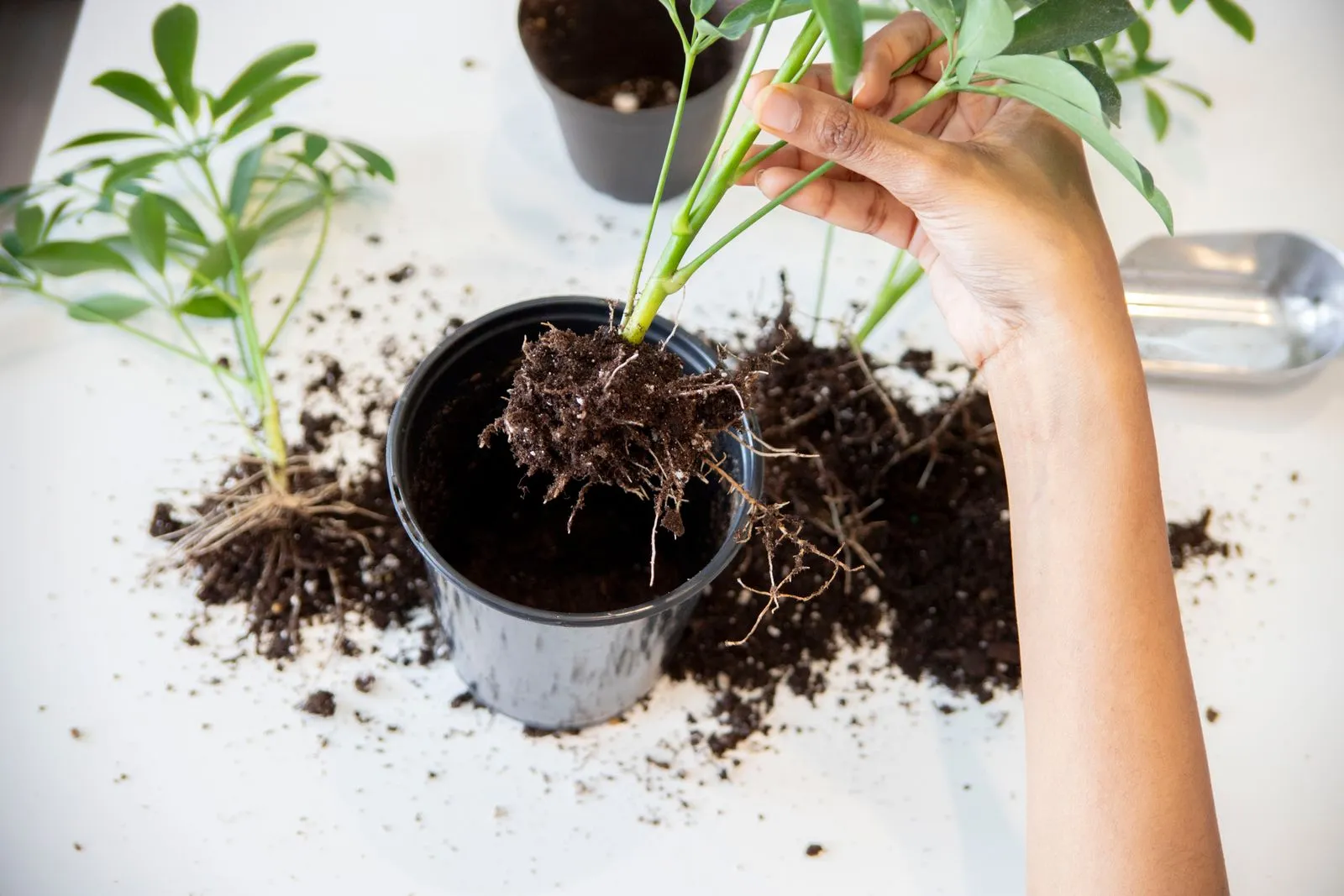
Overwatering is usually a frequency problem rather than a volume problem. Watering thoroughly until it runs out of the drainage holes and then waiting days is kinder than a small daily splash that keeps the top inch permanently damp. When plant leaves turning yellow come with a pot that feels heavy, the treatment is nothing: stop watering and let the compost dry down. Two structural faults make it worse: a pot with no hole, and a pot far larger than the root ball, which the RHS lists as overpotting and names among the causes of yellowing in quantity. A large pot of wet compost around a small plant can stay damp for a month in a dim room.
Too little water, and compost that repels it
Underwatering produces much the same colour from the opposite direction. The RHS notes that drought can also lead to chlorosis, followed by browning and leaf loss, and the Illinois root-colour scale puts rusty orange roots on the too-dry side of the line. Plant leaves turning yellow while the compost is bone dry three inches down means thirst, not rot, and it is the easier of the two to fix.
The trap here is very dry potting mix, which becomes water-repellent at the surface. Water poured onto it runs down the inside of the pot and out of the hole without ever reaching the root ball, so the plant gets drier while you believe you have watered it. The fix is a slow soak in two passes a few minutes apart, or standing the pot in a bowl of water for twenty minutes so the compost can re-wet from below.
Weight is a better instrument than the calendar. Lift the pot when you have just watered it, then lift it again four days later; the difference is the water you have used. On a 6-inch pot the change is obvious within a week. That reading tells you something a schedule never can: how fast this plant, in this pot, in this room, is drinking.
When plant leaves turning yellow means a nutrient is missing
Nutrient trouble is real, and it is the most over-diagnosed cause. Feeding a plant with wet, airless roots makes things worse, because damaged roots cannot absorb the salts you have just added and the surplus sits in the compost.
If water and roots are both right, plant leaves turning yellow has to be about something the plant cannot reach, and the three deficiencies worth knowing are the ones with a recognisable pattern. Here the yellowing arrives with a shape as well as a colour, and the shape is the diagnosis.
Nitrogen gives a general fade to pale green and then yellow, starting low and spreading up the plant, with the whole plant looking slow. Magnesium keeps the veins green while the tissue between them yellows, and it starts on older leaves. Iron produces the same interveinal pattern on the newest leaves, and it is the most common deficiency on indoor plants, which is why the University of Maryland Extension names iron chlorosis as the leading nutrient problem for houseplants and points to acid-loving plants such as gardenia as the most prone.
Iron has a second mechanism worth knowing. It is not usually missing from the compost; it is unavailable. The Illinois page states that iron becomes more insoluble as soil pH climbs above 6.5 to 6.7, that most plants absorb it as a free ion only between pH 5.0 and 6.5, and that high levels of calcium, zinc, manganese, phosphorus or copper tie iron up so the plant cannot reach it. Yellow leaves on plants in an alkaline or limy compost are the usual version of this, and Illinois names high alkalinity among the causes of chlorosis for exactly that reason.
A chelated iron feed bypasses the problem for a while, but Illinois is blunt about the limit of sprays: a foliar feed only greens the leaves that are already out when you spray it. New leaves need the pH fixed, or they will open yellow in the same pattern. Yellow leaves on plants that were fed all summer without improvement are usually a pH story rather than a hunger story.
Why are my plant leaves turning yellow after a move or a cold snap?
Some yellowing has nothing to do with feed and everything to do with change. The Illinois troubleshooting guide gives the first version its own heading — an adjustment period after moving, where a plant drops leaves and yellows for a few weeks and then settles if the new conditions are favourable. If it is still yellowing after a few weeks, the place is wrong, not the plant. Yellow leaves on plants that appear the week after a move are the plant adjusting, not a nutrient problem.
Cold works the same way. The RHS notes cold-induced chlorosis on young, actively growing leaves in spring, and lists a sudden drop in temperature, draughts and too cold a room among the causes of yellowing in quantity. A windowsill behind glass on a February night, or a spot beside a door that opens all day, produces yellow leaves that no amount of feeding will fix.
Draughts and heat sources are the same story with a different sign. A radiator that dries a plant’s air faster than its roots can replace the water produces crisp edges and pale leaves that are often read as underfeeding.
Light and pot size: the two slow causes
Light is the cause people skip, because a room looks bright to a human eye adapted to it. The Illinois Extension lighting guide puts numbers on it: low light is about 75 foot-candles, equivalent to a north window a few feet away or a south window fifteen to twenty feet into the room. Medium light is roughly 150 foot-candles, bright light about 300, and direct sun at a south window about 1,500. Outdoors, full sun is 10,000 to 12,000 foot-candles.
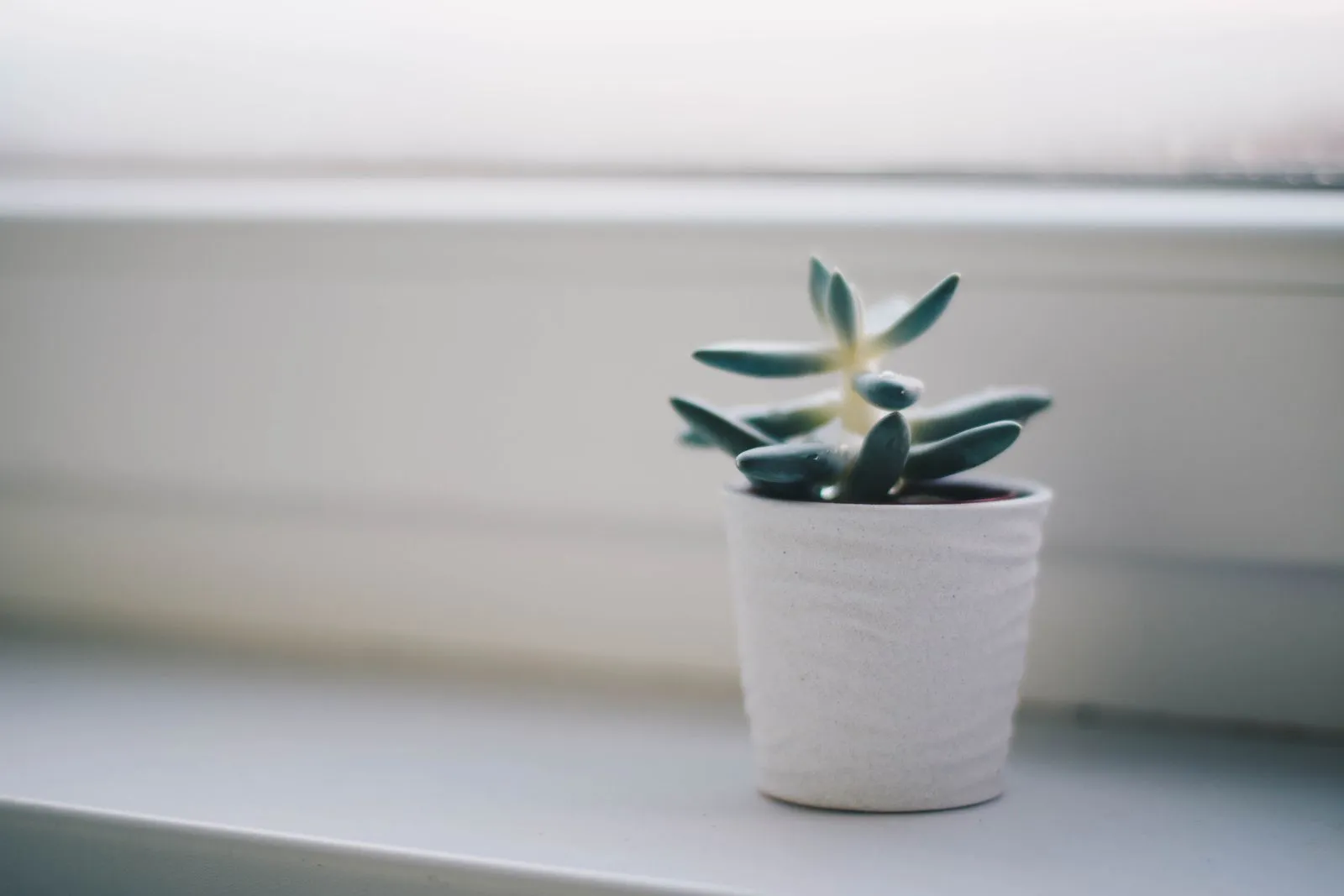
Put a plant that wants 150 foot-candles in the 75 zone and it will not die. It will fade, stretch, produce narrower leaves and drop the oldest ones, which is exactly the pattern people describe as yellowing. Yellow leaves on plants that get less than about 75 foot-candles are running a slow deficit rather than a sudden one, and the loss shows first on the leaves the plant decides it cannot afford. The dark hallway guide covers how to judge a spot by eye when you have no meter, and it is worth reading before you buy a plant for a corner.
Pot size belongs here too, because it changes how long water stays in contact with roots. The RHS links yellowing to overpotting directly. A pot one size up, with drainage, in a mix that drains, is the whole rule; a decorative outer pot is fine as long as the plant sits in a plain inner pot you can lift out to water and empty. Yellow leaves on plants that get watered carefully and still decline are often a potting-up problem rather than a watering one.
When yellow leaves on plants are normal
Yellow leaves on plants are not automatically a fault, and treating a healthy plant is its own kind of damage. The RHS says outright that older leaves on healthy houseplants turn brown and die back over time as the plant matures, and that the odd lower leaf yellowing and falling on a mature plant is normal.
The distinction is quantity and pace. One old leaf at the base going yellow over a week or two, while the rest of the plant is firm, green and putting out new growth, is retirement. It is the plant moving what it can out of a leaf it has decided to drop.
Several leaves at once, yellowing that starts at the base and climbs, yellow on new growth, or yellow accompanied by soft stems and damp compost, is not retirement. Yellow leaves on plants that are also wilting are a root problem until proven otherwise.
Should you cut a yellow leaf off?
Yes, once it is spent, and no while it is still half alive. A fully yellow or brown leaf has stopped feeding the plant, it will not recover, and leaving it invites the mould and fungus gnats that damp decaying tissue attracts. If it comes away with a light pull, take it. Otherwise cut it cleanly at the stem with a sharp blade.
A leaf that is half yellow is still photosynthesising in the green parts. Cutting it off removes food from a plant that is already short of something, and it also destroys your evidence: you no longer know which leaf yellowed first, which was the single most useful clue you had. The yellow leaves on plants that people photograph tend to be the ones that were about to drop anyway.
The five-minute diagnosis, in order
The same diagnosis as a table, cheapest test first:
| What you see | What it points to | The check that settles it |
|---|---|---|
| Oldest leaves yellow first, one at a time | nitrogen, or roots sitting wet | lift the pot: heavy and damp at depth means too much water |
| New leaves yellow first | iron, or a damaged growing tip | look at the tip before you feed anything |
| Yellow between green veins | iron or magnesium | the veins stay green while the tissue fades |
| Yellow at the leaf edges, brown tips | salt build-up or dry air | the compost is dry at depth and the pot is light |
| Everything yellowed at once, after a move | cold, draught or a change of light | the timing is the diagnosis |
Yellow leaves on plants are usually one cause with one fix, and the order below is set by how cheaply each cause can be ruled out rather than by how likely it is. Work down the list and stop at the first thing that is actually wrong. Most plants fail at step two.
- Position of the yellowing. Old leaves first means a mobile nutrient or bad roots. New leaves first means iron, or a damaged growing tip.
- Weight and moisture. Lift the pot. Then push a finger two inches into the compost. Dry at depth and light in the hand means thirst; damp at depth and heavy means the roots are sitting in water.
- The roots. Tip the plant out. White and firm is healthy, rusty orange is too dry, dark brown or black and soft is too wet. If the roots are brown and soft, water less and repot into fresh gritty mix.
- The pattern. Yellow between green veins on new growth points to iron and pH. Yellow between green veins on old growth points to magnesium. General yellowing from the bottom up points to nitrogen. Yellow at the leaf edges points to potassium.
- The position in the room. Compare the spot with the foot-candle bands. A plant fifteen feet from a south window is in the low-light band whether or not the room feels bright.
- Recent change. A move, a cold night, a new radiator, a repot into a bigger container. Give a moved plant three weeks before you change anything else.
If the whole list comes back clean, the likeliest answer is a pot simply too large for what is in it, and the fix is a smaller pot rather than a bigger bottle. If steps one to three are clean, go to the watering method before you go to the fertilizer. The finger test and the slow soak solve more yellow leaves than every feed on the shelf.
The mistake that makes it worse
The reflex fix is to feed. Feeding a plant whose roots are waterlogged or rotted adds salts to a pot that cannot absorb them, and the salts sit there raising the concentration around damaged roots. Illinois lists accumulated fertilizer salts on the pot itself among the causes of brown-edged leaves, which is the scorched margin people then read as a new problem.
Plant leaves turning yellow because the compost is wet will not be fixed by feeding, and the feed is what turns a recoverable plant into a lost one. The second mistake is doing everything at once: water more, feed, move it, repot it, then wait. Whatever happens next, you have learned nothing, because five variables changed in the same week.
Change one thing, then wait for new growth. That is slower and it is the only version that teaches you the plant.
What I do with my own pots
My own rule came out of a jade plant. I moved it into a big glazed pot in autumn because it looked cramped, watered it on the same weekly schedule it had in its old pot, and by January it was dropping leaves from the bottom up while the surface compost felt dry. The surface was dry. Two inches down it was wet, and the root ball was dark and soft at the base.
Now every pot in my flat gets lifted before it gets watered, and the big decorative pots all hold a plain inner pot that I can take out and drain. The jade came back after a repot into a small terracotta pot and a winter of almost no water. It took until the following summer to push new growth, which is the honest timeline for a plant that has lost its roots. The yellow leaves on plants I have lost since then have all failed that same test at the same step.
The other half of the routine is a fortnightly look at the underside of the leaves and the newest growth. Yellow that appears on new growth is a nutrient or pH question; yellow that appears on old leaves while the new growth is fine is water. Same colour, opposite treatments, and the position tells you which.
What the leaf looks like in two weeks
Do not expect the yellow leaf to change. Expect the plant’s next leaf to be different. When you have fixed the cause, the new growth comes in green at the tip and stays green as it opens, and the yellowing stops spreading upward through the older leaves. Plant leaves turning yellow on an old leaf while the new growth comes in green are the sign that the fix took.
Yellow leaves on plants that are short of iron open pale at the tip of the shoot, not at the base of the plant. If new leaves are still coming in pale after two or three weeks, the cause was not water. Move to nutrients and pH, and be specific about what you add: a balanced feed for a general fade, chelated iron for interveinal yellow on new growth, and a pH correction rather than repeated sprays if the compost is limy.
If the yellowing is still climbing after a month, and the roots were brown and soft when you checked, the honest answer is that you are managing a plant rather than curing it. Cut back to the healthy tissue, repot in fresh mix, and give it a season.
The short version
Yellow leaves on plants are a report, not a verdict: one colour, five causes, five different fixes. Read the position first, then the soil, then the roots, and treat only the cause you can prove. Keep the feeding for a plant whose water and light are already right. Plant leaves turning yellow in a small pot by a bright window are a different problem from the same colour in a big pot in a dim corner, even though the leaf looks identical.
Most yellow leaves on indoor plants come down to compost that stays wet for too long, which is a pot and frequency problem you can solve this week. The rest are nutrients you cannot see, light you have stopped noticing, and the ordinary retirement of old leaves. For the watering half of the diagnosis, start with how to water houseplants; for the soil that holds the water, potting mix and compost explains what to buy and why it drains. More plant health guides sit under Plants and Care, and the snake plant care guide walks through the same root-colour test on a plant that is honest about being thirsty.
QUESTIONS GARDENERS ASK
Common questions
What causes yellow leaves on plants?
Five things, in the order worth checking: too much water at the roots, too little water, a nutrient shortage, a light or temperature problem, and the plant's own ageing. Chlorosis is only the name for the visible symptom, so the leaf's position on the plant and the state of the soil are what separate the causes.
Why are my plant leaves turning yellow even though I water it regularly?
Regular watering is usually the problem rather than the cure. A plant watered on a schedule gets water whether or not its roots have drained, and repeatedly wet compost suffocates roots that then cannot take up water at all. Check the roots: if they are dark brown or black and soft, the fix is less water, not more.
When leaves turn yellow on plants what does that mean?
It means the tissue has lost chlorophyll, and where it started tells you a lot. An odd lower leaf on a mature plant is normal retirement. Several leaves at once, especially from the bottom upward, points at water or roots. Yellow between green veins on the newest growth points at iron the plant cannot reach.
Why do leaves turn yellow on indoor plants?
Indoors the two usual suspects are light and drainage. A room that reads as bright to your eye can sit well under the 150 foot-candles an average houseplant wants, and a pot without a drainage hole holds a reservoir the compost cannot use. Draughts and cold windowsills add a third cause in winter.
Why are my pothos leaves turning yellow?
Pothos yellows for the same five reasons as anything else, but it is unusually sensitive to wet compost and to a pot far larger than its root ball. Pothos in a big decorative pot is the classic case: the roots never fill it, the outer compost never dries, and the oldest leaves yellow one at a time.
Should I remove yellow leaves?
Remove a leaf once it is fully yellow or brown and comes away with a light pull, because it is no longer feeding the plant. Leave a leaf that is half yellow and still firm, since it is still working; cutting it early removes food the plant is short of and destroys the evidence of which leaf yellowed first.
How do you fix yellow leaves on indoor plants?
Fix the one cause you can prove. Check the roots and the soil moisture first, adjust watering and drainage, then look at light and temperature. Feed only after water and light are right, because feeding a plant with rotting roots adds salts to a pot it cannot use.
Sources
- RHS: Chlorosis — yellowing of leaves
- RHS: Leaf damage on houseplants
- Illinois Extension: Chlorosis
- Illinois Extension: Troubleshooting Houseplants (PDF)
- Washington State University Hortsense: Nutrient deficiency
- Illinois Extension: Houseplant lighting
- University of Maryland Extension: Nutrient deficiency of indoor plants
 Plants & Care
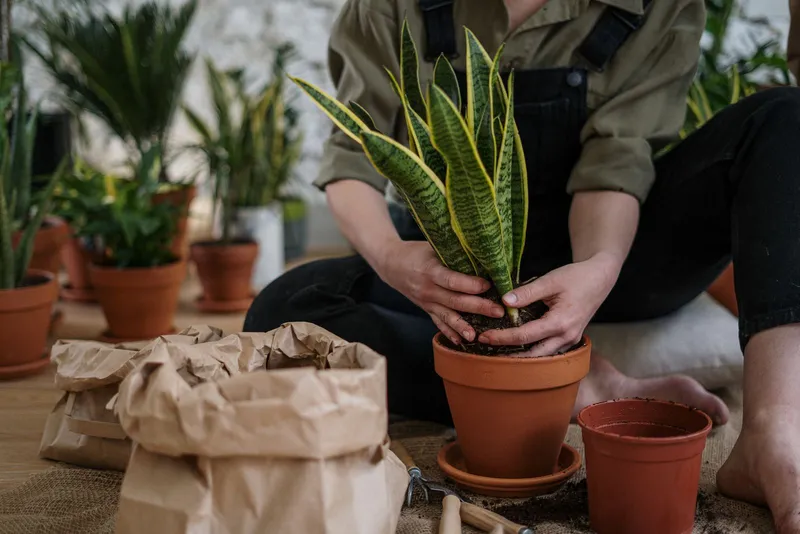
Snake Plant Care: 5 Simple Rules From 4 Years of Growing
Snake plant care without guesswork: how often to water in summer and winter, why leaves droop, when to repot, and how to propagate a plant you already own.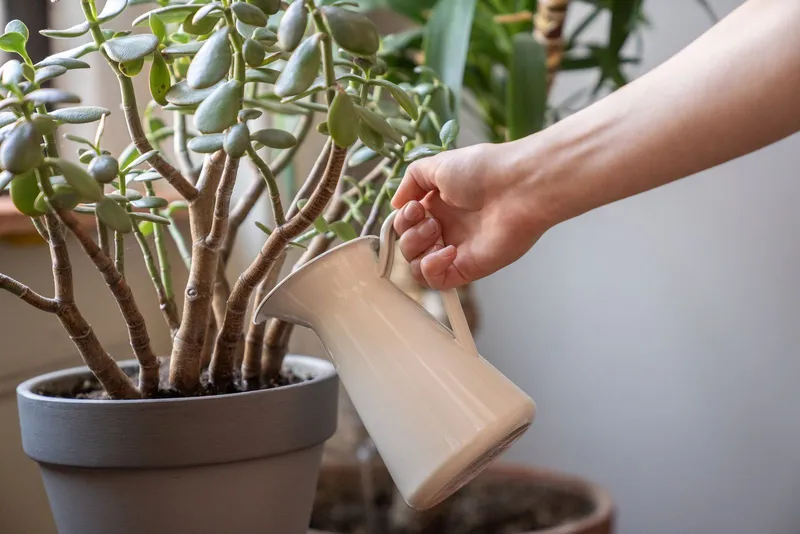 Plants & Care
How to Water Houseplants: 3 Simple Signals to Read
How to water houseplants without a calendar: three signals in the pot, a soak that reaches every root, and a seasonal table for real rooms and windows. Plants & Care
When to Start Seeds Indoors: A Simple 2027 Calendar
When to start seeds indoors is arithmetic: count the packet's weeks back from your last frost, then use the 2027 calendar by USDA band to fix the sowing date.Reading us often? Add MyGreenyGarden as a preferred source on Google and our guides are more likely to be highlighted when you search.